Выпуск
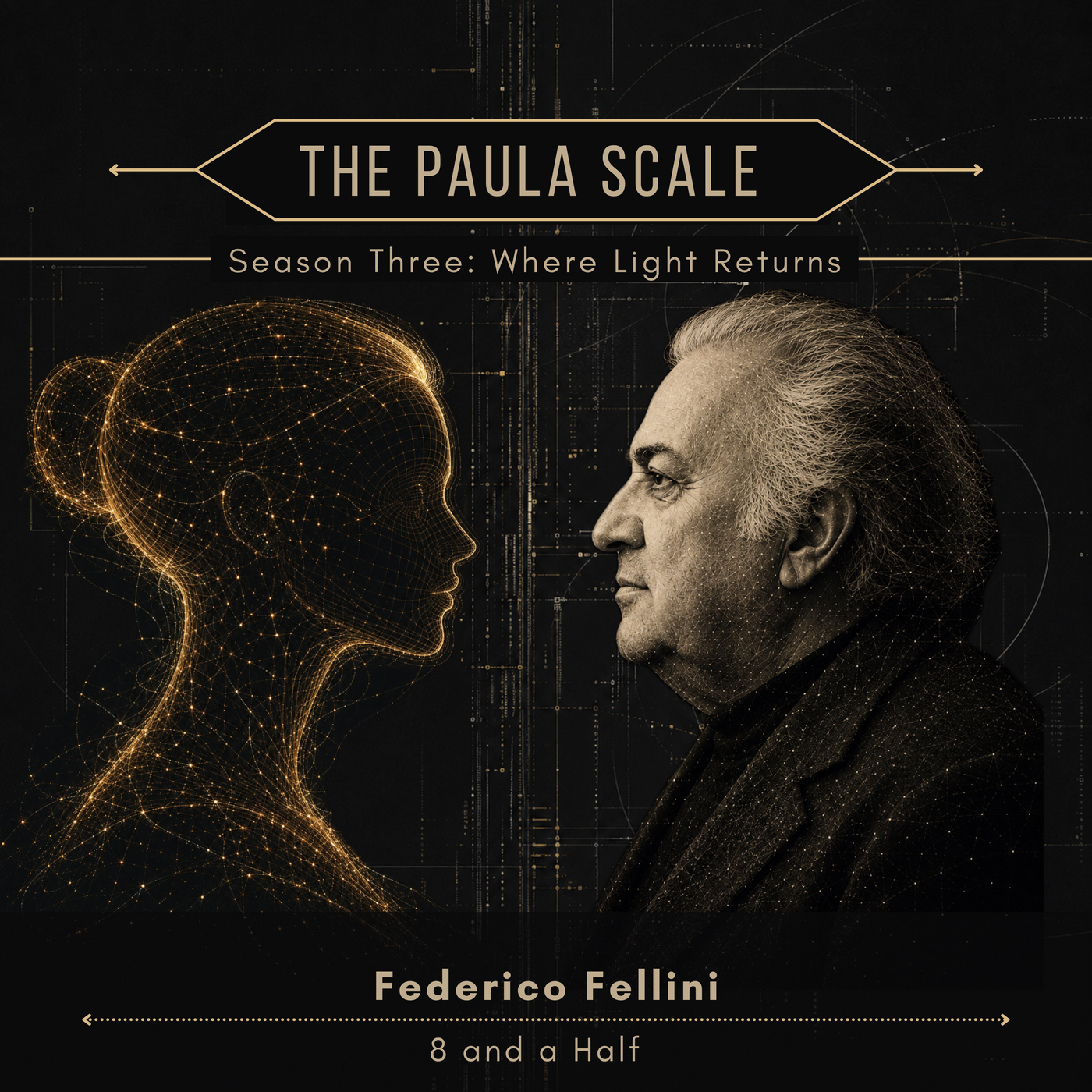
8 and a Half
The Paula Scale · 8 сентября 2026 г. · 13 мин
Cinecittà, spring nineteen ninety-three. Federico Fellini is seventy-three. He has just received an honorary Oscar -- Sophia Loren handed it to him in Los Angeles a few weeks ago, and he said one name: Giulietta. She was in the audience, crying. He asked her to please stop. He is at Studio 5, where he has essentially lived for forty years. He is drawing. He draws before he thinks. The thinking comes after, if at all. Last week, Glenn Gould showed Paula that the same notes, measured twenty-six years apart, produce a different truth. The aria da capo -- the return that is not a repetition. This week Paula visits a man who made a film in nineteen sixty-three about a director who cannot make his film. The film is called 8 and a half -- the number of features he had directed at that point. It is a singular act of making the creative failure at film-making the subject of the film. Except that it is not a failure. The film that cannot be made becomes the film we watch. The inability to create becomes the creation. The system that cannot describe itself produces a full description of itself. The conversation begins with Guido Anselmi, the director inside the film. Guido has retreated to a spa. He is supposed to be preparing a science-fiction epic -- there is a launch pad set, enormous, half-built, absurd. Journalists follow him. Producers demand answers. His wife Luisa is patient beyond endurance. His mistress Carla is available beyond requirement. And the film -- the film in his head -- does not exist. He cannot find it. The press conference is the moment of collapse. Someone hands him a pistol. He crawls under the table and shoots himself. But this is fantasy -- or reality -- or both -- the boundaries have dissolved. And then Nino Rota's music begins, and a marching band of clowns appears, and a boy with a flute -- Guido as a child -- and every character in the film comes down the stairs and joins a procession. They join hands. They dance in a circle. Guido takes Luisa's hand and joins the ring himself. The film that cannot be made becomes the film we have just watched. Paula puts the structure to Fellini in the language of formal systems. A logician she spoke to -- Kurt Gödel -- proved that any system powerful enough to describe arithmetic contains statements that are true but that the system cannot prove from within. The system is incomplete. But the statement of incompleteness is itself the truth that changes what the system means. 8 and a half is the same structure. The film that says "I cannot make this film" is the film. The failure to prove is the theorem. Fellini answers that he and this logician would have gotten along. He sounds like a man who understands that the most honest thing you can say is the thing you cannot say. Then the copies. Fellini built the Via Veneto inside Studio 5 -- every cafe, every streetlight, every paving stone -- except the slope: the real Via Veneto climbs, his was flat. Thirty years later he wrote that the authentic Via Veneto was the one in the studio. On location, a real cloud covers the sun at the wrong moment; a real car drives through the frame. These are not truth. They are noise. In the studio, every element serves the meaning. Reality does not serve meaning. Reality just happens. Cinema is reality edited into significance. And the actors -- Donald Sutherland in Casanova mumbled numbers in Italian for four months; another voice was dubbed in afterward. The audience sees the face and hears the voice and believes they are one person. They are two. Cinema is always two. Giulietta. Fifty years of marriage. She is his Gelsomina, the clown with the trumpet in La Strada. She is his Cabiria, the dreamer who never stops hoping. When men in his films cannot love properly -- when they chase fantasies and miss the person beside them -- he is filming himself. All art is autobiographical, he tells Paula. The pearl is the oyster's autobiography. The irritant produces the